

8:45 AM – 9:45 AM | Registration & Networking | Light Breakfast & Refreshments provided by Western Midstream
9:45 AM – 10:00 AM | Welcome | Greg Perrin | General Manager, RCGCD
10:00 AM – 10:25 AM | Chevron & Microsoft | Kilby Data Center
Jonathan Harshman – Public and Government Affairs Advisor, Chevron U.S.A. Inc.
Brian K Bohm, P.G. – Senior Subsurface Specialist – Water, Chevron
Christina C Guzman, MA, CESCO, CRAME – Microsoft, Sr. Manager Community Affairs – Texas
Presentation Title: Project Kilby: Powering West Texas’ Technology Infrastructure Responsibly
Description: Microsoft and Chevron will explore how Project Kilby connects the Permian Basin’s energy, infrastructure, and workforce advantages with growing demand for computing capacity, including the project’s approach to dedicated power, water management, responsible development, and community benefits.
10:25 AM – 10:50 AM | Core Scientific Data Centers
Carol Haines – Chief Power & Policy Office, Core Scientific
Presentation Title: Water and Community Stewardship
Description: A discussion on the future of the region and how growth and development can align with strong community stewardship
10:50 AM – 11:15 AM | Google Data Centers
Farish Mozley – Government Affairs & Public Policy Manager, Google
Presentation Title: Google in Texas: Water Stewardship
Description: Google’s approach to being a good neighbor and responsible steward of shared natural resources.
11:15 AM – 11:40 AM | Data Centers
Rachel Hanes – Policy Director, Greater Edwards Aquifer Alliance
Presentation Title: Data Centers in Texas: Policy Considerations and Recommendations
Description: An overview of the changing landscape of data center growth in Texas, policy challenges and considerations related to water use and other impacts, and policy recommendations to respond to the identified challenges.
11:40 AM – 12:00 PM | Data Center Panel Discussion
Panelists: Greg Perrin, Jonathan Harshman, Christina Cisneros, Brian K Bohm, P.G., Carol Haines, Farish Mozley, Rachel Hanes
12:00 PM – 1:00 PM | Lunch provided by Chevron & Special Presentation
Billy Tarrant – Interim Director, Meadows Research Institute for West Texas Water at Sul Ross State University
Presentation Title: The Meadows Research Institute for West Texas Water: Helping West Texans Manage our Most Precious Resource
Description: The future of Far West Texas depends on strengthening our collective understanding of water resources and expanding the tools, workforce, and partnerships needed to steward them wisely. That is the purpose of the Meadows Research Institute for West Texas Water.
1:00 PM – 1:25 PM | Pecos River Assessment
Mauricio Eduardo Flores – Research Hydrologist, Southwest Research Institute
Presentation Title: Pecos River Characterization Project
Description: An overview of progress of the ongoing WaterSMART project focusing on characterizing streamflow gain/loss and water quality of the Pecos River, specifically from Imperial, TX to the river’s confluence with the Rio Grande.
1:25 PM – 1:40 PM | Produced Water Reuse
Dr. Chad Unrau – Vice President, Beneficial Reuse and Industrial Water, Western Midstream
Presentation Title: From Produced Water to Reclaimed Freshwater: What We’re Learning in West Texas
Description: Dr. Chad Unrau, Vice President of Water Solutions at Western Midstream, will discuss how three years of research and real-world demonstration are helping evaluate the potential for beneficial reuse of produced water. He’ll highlight the progress of the Joint Industry Project (JIP), key findings to date and what this work could mean for the future of water in West Texas.
1:40 PM – 2:15 PM | Produced Water Reuse
Adrianne Lopez – Research & Development Director, Texas Pacific Water Resources, LLC
Presentation Title: Texas Pacific’s 10K BPD Desalination Facility
Description: Texas Pacific Water Resources will be presenting about their new 10K BPD produced water desalination plant, the R&D that went into validating the water quality, and their plans for operation
2:15 PM – 2:40 PM | Failed Wells
Hawk Dunlap – President, Zombie Wells LLC
Presentation Title: Why and How Wells Fail
Description: A brief overview of the mechanisms for well design, construction, and failure from 35 years in the oil and gas industry.
2:40 PM – 3:00 PM | Closing Panel Discussion
Panelists: Greg Perrin, Mauricio Flores, Chad Unrau, Adrianne Lopez, Hawk Dunlap
3:00 PM – 5:00 PM | Post-Conference Networking Event Sponsored by Microsoft & Wester Midstream
Location: Ol’ Barry’s Surf Club and Alpine Lodge Restaurant
Address: 133 South Frontage Road, Pecos, Texas 79772
The next regularly scheduled Board Meeting will be held on October 15th, 2026, at the regular time and location.
The Mission of the District is to develop rules to provide protection to existing wells, prevent waste, promote conservation, provide a framework that will allow availability and accessibility of groundwater for future generations, protect the quality of the groundwater in the recharge zone of the aquifer, ensure that the residents of Reeves County maintain local control over their groundwater, and operate the District in a fair and equitable manner for all residents of the District.
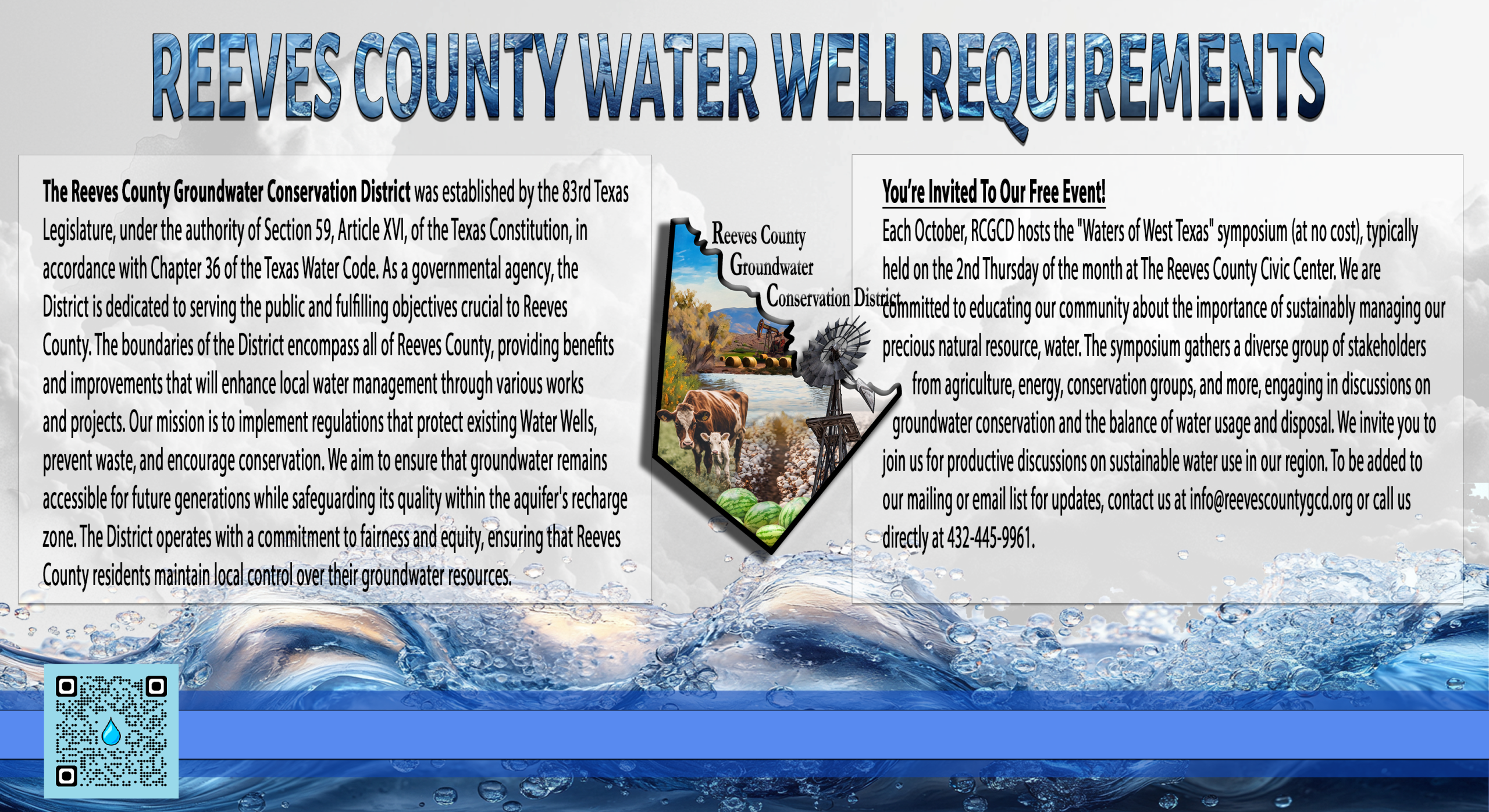

The Reeves County Groundwater Conservation District (the “District”) was created by the 83rd Texas Legislature under the authority of Section 59, Article XVI, of the Texas Constitution, and in accordance with Chapter 36 of the Texas Water Code (“Water Code”), by the Act of May 17, 2013,
83rd Leg., R.S., Ch. 457, codified at Texas Special District Local Laws Code Chapter 8876.
The District is a governmental agency and a body politic and corporate. The District was created to serve a public use and benefit and is essential to accomplish the objectives set forth in Section 59, Article XVI, of the Texas Constitution. The District’s boundaries are coextensive with the boundaries of Reeves County, Texas, and lands and other property within these boundaries will benefit from the works and projects that will be accomplished by the District.
Selecting a language translates this page and menu with Google Cloud Translation. Page text is sent to that service; form entries are excluded.
Reads visible page text aloud using your browser. Use a dedicated screen reader for complete navigation.
Display preferences help you browse this site. They do not repair every accessibility issue. Read-aloud depends on available browser voices. Controls cannot change content inside other websites’ embedded frames.